By Analyst Team · Updated 2026-08-07 · 15 min read
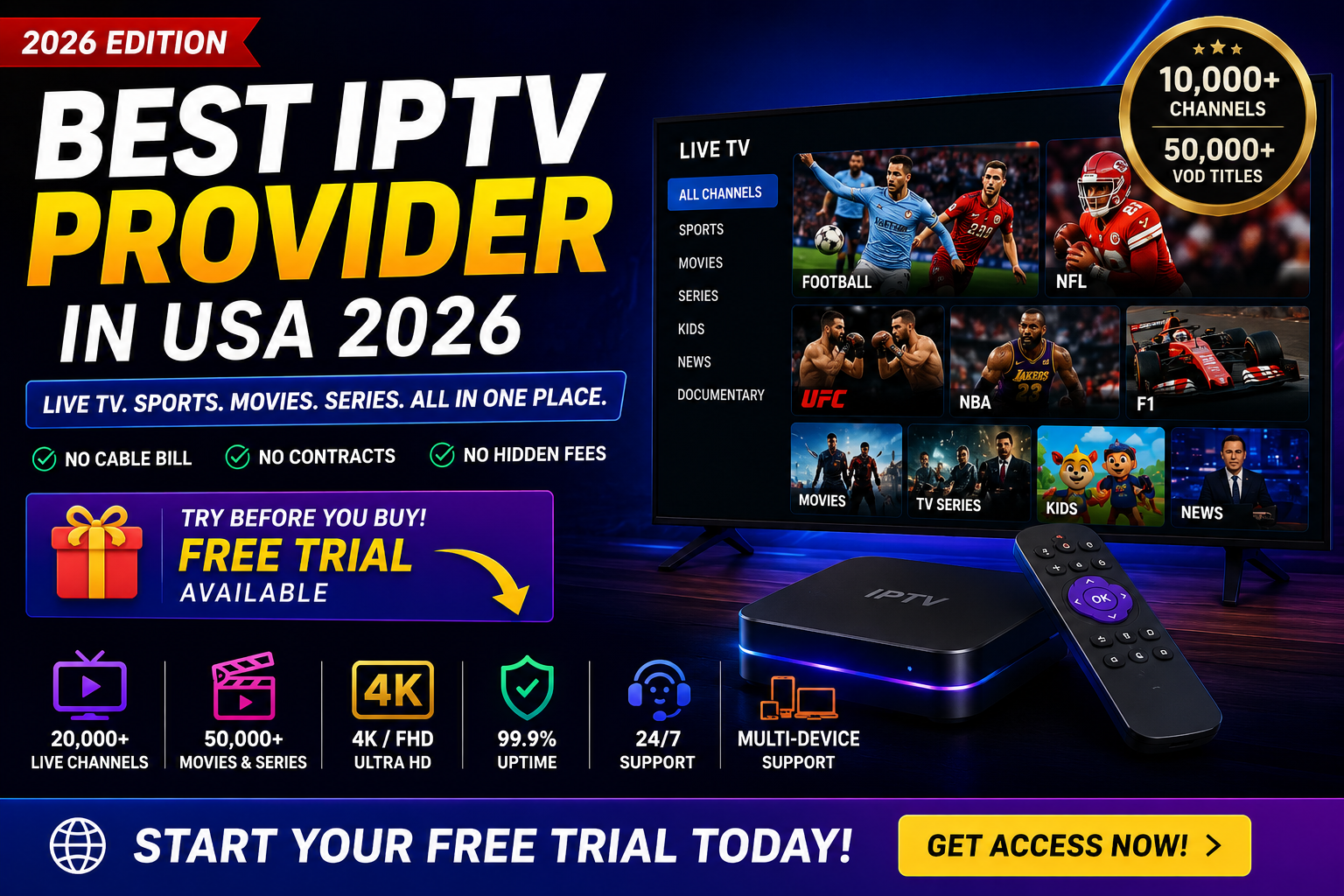
An IPTV subscription service streams live television and on-demand video over your internet connection, replacing the traditional cable box or satellite dish. The global IPTV market has grown rapidly because viewers want more channels, more flexibility, and better device support — all without the heavy contracts that old-school TV providers force on you. Whether you are a cord-cutter, a sports fan, or an expat looking for home-country programming, the core question is always the same: how do you choose a service that actually works without getting scammed? This guide answers that directly, with practical advice you can use today.
The screen shown above gives you a realistic look at a modern IPTV subscription service in action: a clean programme guide, sports channels, movie categories, and a search bar built into one interface. Understanding that layout matters because the best services invest heavily in a good user interface, while fly-by-night providers often give you a broken app and a raw M3U list. A polished dashboard is usually your first sign of a professional operation.
Ready for a side-by-side test? The IPTV subscription service featured here offers a free trial window so you can validate the quality before committing a single payment.
What is an IPTV subscription service exactly?
IPTV stands for Internet Protocol Television. In plain language, it means delivering television signals as data packets over an IP network — the same network that powers your broadband connection. Instead of tuning into a specific frequency on a coaxial cable or satellite dish, your app connects to a remote server, requests a channel, and receives a continuous video stream over the internet.
An IPTV subscription service can come in several forms:
- Licensed IPTV offered by telecom operators as part of a fibre or broadband bundle.
- OTT streaming services such as YouTube TV, Hulu + Live TV, and Sling TV, which are technically IPTV products.
- Independent IPTV resellers offering large channel line-ups at low monthly prices — this is where you need to be careful.
You will frequently encounter these terms while researching:
- VOD: video on demand, the library of movies and series available inside the service.
- EPG: the electronic programme guide that tells you what is airing now and next.
- M3U playlist / Xtream Codes: the access links that connect your player app to the provider's server.
- Middleware: the backend software that organises channels, users, and billing.
- CDN: content delivery network, the distributed servers that actually stream the video to you.
The key distinction to remember: not all IPTV services are legal. Licensed operators secure rights from broadcasters; many resellers do not. That difference affects price, stability, and the risks you take as a subscriber.
LIMITED TIME AVAILABILITY
Unlock Full iptv subscription service Access
Secure special promotional rates instantly before the window closes. Lock in your pricing model today before plans return to standard regional metrics.
How an IPTV subscription service works step by step
When you subscribe, the provider gives you a login or a playlist file. That file points to their streaming servers, with channel categories and logo metadata. When you open the app, the request goes through these steps:
- You select a channel; the app calls the provider's server using EPG and playlist data.
- The server authenticates your subscription and locates the channel stream.
- The stream is delivered from a CDN edge server close to your geographic location.
- The video is decoded by your device — a smart TV, phone, Fire Stick, MAG box, or Android box — and displayed on screen.
A smooth experience depends on three factors working together: the provider's server redundancy, your internet bandwidth, and your device's decoding capability. A service that performs well on a high-end box may buffer on an old smart TV with a slow processor and limited RAM.

Concrete benefits for users
The dashboard shown below is a typical view the moment you open a quality IPTV subscription service on a smart TV. Everything is organised into categories — live sports, news, movies, kids, international — which makes the daily experience feel more like a premium platform than a hobby-grade stream list. That level of polish is one reason viewers stay once they find a strong provider.
1. Huge channel selection
Most IPTV packages include far more channels than cable — 1,000 to 10,000 options are advertised. You get sports, movies, documentaries, kids' channels, and news from almost every country. For a viewer who wants international variety, the breadth is hard to beat.
2. Cost advantage
Independent IPTV plans range between $5 and $20 per month, far lower than cable bills that average $60–100. The value is attractive, but keep in mind why the price is low: licensing is often missing. Budget-conscious buyers should compare the true cost of a reliable provider against a legal OTT bundle.
3. Device flexibility
You can watch the same IPTV subscription service on a smart TV, Android box, Firestick, iPad, and phone — often at the same time. Multi-screen support is a major advantage for families where different members watch different content at the same hour.
4. VOD + live in one app
Instead of juggling Netflix and a live TV package, you get both: live channels plus an on-demand library that can include films premiering in cinemas. This convenience is one of the biggest reasons people cancel traditional TV entirely.
5. Catch-up and recording
Quality providers include catch-up TV that lets you replay programmes that aired in the last 3 to 7 days. A few even offer cloud DVR features, bringing the convenience of a PVR to any device — even a phone.
Most flexible option. Want to start small? A one-month affordable IPTV subscription plan lets you evaluate streaming quality without a long-term commitment.
Honest limitations and risks you should know
No IPTV subscription service is perfect. Be honest about the downsides before you buy, because a little due diligence now saves you a frustrating weekend of outages later.
- Legal risk. If you use an unlicensed provider, you are accessing pirated streams in most countries. While viewers are rarely prosecuted, it still carries legal and ethical issues.
- Stability issues. Channels disappear, streams buffer during big matches, and EPGs occasionally list the wrong programme.
- ISP throttling. Some internet providers actively throttle streaming-heavy connections. You might need a VPN to maintain a consistent bitrate.
- Support quality. If something breaks in the evening, there is no 24/7 call center — just a WhatsApp message or email that may take hours to answer.
- Security exposure. Sideloading APK apps can expose your device to malware if you trust the wrong source.
Pros
- Massive channel catalogue with global reach
- Low monthly cost compared to cable or satellite
- Works on nearly every modern device
- VOD library bundled with live channels
- Multi-screen and catch-up features
Cons
- Legal grey areas with unlicensed providers
- Potential buffering and server downtime
- ISPs may throttle streaming traffic
- Support can be slow or unhelpful
- Quality varies dramatically between providers
Unlock complete high-definition information and priority access packs.
Claim This Special Offer for IPTV Subscription Service →IPTV vs. cable vs. satellite vs. streaming platforms
The table below puts the options side by side. It shows why an IPTV subscription service is so attractive, and also why it is not always the smartest choice for every household.
| Feature | IPTV Subscription Service | Cable TV | Satellite TV | Streaming Platforms |
|---|---|---|---|---|
| Delivery method | Internet (IP) | Coaxial cable | Satellite dish | Internet (OTT) |
| Average channel count | 1,000+ (often 5,000–10,000) | 100–400 | 200–600 | 1–100 originals / no linear TV |
| Device support | Smart TV, phone, tablet, PC, set-top box | TV only | TV with receiver box | Smart TV, phone, tablet, PC, console |
| Live sports coverage | Excellent (with right provider) | Excellent | Excellent | Limited to licensed events |
| Typical monthly cost | $5 – $20 | $60 – $120 | $70 – $150 | $10 – $40 |
| Legal clarity | Varies by provider | Fully regulated | Fully regulated | Fully licensed |
| Contract flexibility | Monthly, quarterly, yearly options | 12–24 months | 12–24 months | Monthly, cancel anytime |
| Quality consistency | Varies by server load | Stable | Stable (weather dependent) | Stable |
Who is an IPTV subscription service for?
An IPTV subscription service is not a one-size-fits-all product. Here are the user profiles that benefit most:
- The cord-cutter: someone who wants to escape a $100 cable bill but still watch live news and sports. IPTV offers a far cheaper path, provided they pick a reliable provider.
- The sports fan: a viewer whose team plays in a different league or a different country. IPTV gives access to international sports packages that are not available locally.
- The expat: someone living abroad who wants home-country channels, local news, and familiar shows. IPTV keeps them connected to their culture.
- The budget family: households that want a big channel line-up, VOD, and multi-room streaming without paying premium subscription fees.
- The tech enthusiast: users with a Firestick, Android box, or smart home setup who enjoy customising their entertainment stack with VPNs, launchers, and players.

How to get started with an IPTV subscription service
The image below shows the simple hardware chain behind a typical IPTV subscription service: a router delivering internet, a streaming device or IPTV box, and a screen. Once your hardware is ready, follow these practical steps:
- Check your internet speed. Run a speed test, ideally over Ethernet. For 1080p streaming you need at least 20 Mbps; for 4K and multi-room viewing, 50 Mbps or more is recommended.
- Define your device. Decide whether you will use a smart TV app, a Firestick, a dedicated IPTV box, or a phone. That affects the app you need to sideload or install.
- Demand a free trial. Reputable providers offer a 24-hour, 48-hour, or 7-day trial. Test the service during peak evening hours — that is when servers are strained.
- Start with a one-month plan. Avoid yearly plans until you have verified quality over several weeks. One month is enough time to reveal buffering issues or EPG problems.
- Install the player app. Popular paid players include IPTV Smarters Pro, TiviMate, and iMPlayer. The provider will send an M3U link or Xtream Codes login for the app.
- Configure and test. Load the playlist, enable EPG, and set a custom category order. Flip through channels, test catch-up, and watch a live sports event to measure stability.
- Protect your privacy. If you are using an unlicensed provider, consider a VPN to avoid ISP throttling and to keep your viewing activity private.
If anything feels wrong during the trial — constant buffering, missing channels, or an EPG that does not load — walk away. A quality provider will happily answer your questions before you pay.
Final Subscription Window:
Main Offer Today →Affiliate Disclosure: Clicking this secure link verified by our network supports our team through standard partnership terms at zero extra cost to your invoice.
Frequently Asked Questions
1. How do I buy an IPTV subscription service safely?
Buying safely comes down to a few principles. Avoid flashing ads and anonymous Telegram deals that demand crypto-only payments. Look for a provider with a clear website, customer support, payment via credit card or PayPal, and a free trial. Read recent, dated reviews from real users across forums, but remember that review sites may be affiliate-driven. Start with a short one-month plan to test stream stability, EPG accuracy, and device compatibility before committing long-term. If a provider requires you to disable your antivirus to install their app, that is an immediate red flag.
2. Where can I find a reliable IPTV service without getting scammed?
A reliable provider shows itself through transparency: a public website, published pricing, easy trial signup, and responsive support. Trusted recommendations often come from established tech blogs and users who post device-specific videos on YouTube. Avoid providers whose only presence is a Telegram channel and a screenshot of 10,000 channels. Search for phrases like "best IPTV subscription service 2025" and cross-check the same provider appearing across multiple independent sources. Finally, reject any operator that promises unlimited lifetime access for a one-time fee — those companies disappear within months.
3. Can I trust "best IPTV subscription service 2025" reviews on Reddit?
Reddit threads like r/IPTV can offer genuine user experiences, but you need to read with caution. Many review posts are astroturfed by resellers posing as customers; an easy test is to check the user's post history. When someone recommends a service, look for specifics — server load, EPG accuracy, buffering during peak sports events — rather than generic praise. Combine Reddit insights with a paid trial period and make your own judgement. Remember that what works in one country may be terrible in another because your ISP's routing is part of the video quality equation.
4. Are affordable IPTV subscription plans actually reliable?
Yes and no — affordable usually means $8–15 per month for 1,000+ channels, which is only economically possible without proper rights fees. Some cheap plans are excellent because the provider invests in servers and bandwidth rather than licensing; others are short-lived operations that shut down quickly. Reliability depends on server infrastructure, not price. Read the provider's refund policy and see how long they have been operating; a service with a stable customer base for over 3 years is more reliable than a brand-new $5 "everything included" offer.
5. Can I test an IPTV service with a free trial before paying?
Most serious providers offer a 24-hour or 48-hour free trial, and some go up to 7 days. Use the trial to test three things: channel stability in the evening peak, the look and accuracy of the EPG, and app compatibility with your device. Do not sign up for paid plans with your main email and card if the trial registration feels dodgy; safer providers keep the process simple. Also, use a trial to check whether your internet connection can handle the service — if it buffers on 1080p, it will struggle on 4K.
6. What is the best IPTV for sports channels?
If sports are your priority, you want a provider with strong premium sports coverage, including pay-per-view boxing, football leagues, and multi-language commentary options. The best IPTV subscription service for sports tends to have redundant servers because live sports consume enormous bandwidth. Check whether the service offers catch-up features for matches that start after you tune in. Also remember that unlicensed sports resellers are actively pursued by rights holders in some countries; a VPN may be necessary to protect your privacy.
7. Are there legal IPTV subscription providers?
Yes. Telecom operators and OTT platforms offer fully licensed IPTV. Examples include AT&T TV, Verizon Fios over fibre IP, YouTube TV, Hulu + Live TV, and Sling TV. These are legitimate alternatives for users who want legal clarity and predictable monthly bills. The main trade-off is price and flexibility: legal providers offer fewer exotic international channels and usually cap simultaneous streams. If you are interested in a specific international package, check whether the original broadcaster offers a direct subscription service in your country.
8. What internet speed do I need for a stable IPTV subscription service?
For standard definition and 1080p content, a stable 15–25 Mbps connection works, but for 4K and multiple streams, you should have at least 50 Mbps. Speed is not everything — latency and packet loss cause most IPTV buffering, so a wired Ethernet or strong 5GHz Wi-Fi connection beats a distant 2.4GHz router signal. Test your connection to the provider's server during peak hours (8–10 PM) to see the realistic experience. You should also check if your ISP throttles streaming traffic; a VPN can help bypass that when needed.
Conclusion: your next step with an IPTV subscription service
An IPTV subscription service can deliver an incredible viewing experience — global channels, flexible plans, and a fraction of the cost of traditional TV. The trick is to separate reliable, well-supported providers from short-lived resellers that disappear after your first monthly payment. Stick to the essentials: test with a free trial, pay monthly initially, check privacy protections, and read recent user feedback.
The industry is messy, but the payoff is real once you find a provider with stable servers, clean EPG data, and honest support. If you are ready to test a service that matches the criteria above, take advantage of the special offer linked in this guide. It lets you experience a professional IPTV subscription service on your own connection before deciding — the smartest way to start any streaming subscription.
Ready to begin? Claim your special iptv subscription service access now.
Get This Offer →24/7 support · Multi-device streaming · Free trial available